Ecomuseo Colombano Romean
 Didattica
Ecomuseo Colombano Romean
Ecomuseo
Salbertrand
Cultura materiale
Cultura immateriale
Storia
Colombano Romean
Didattica
Ecomuseo Colombano Romean
Ecomuseo
Salbertrand
Cultura materiale
Cultura immateriale
Storia
Colombano Romean
Ultimo aggiornamento: Aug. 27, 2026

Hemp mill - Luca Giunti
"THE ECOMUSEUM is an action carried out by a COMMUNITY, starting from its HERITAGE, for its DEVELOPMENT" (Hugues de Varine)
Every Ecomuseum is conceived and built with and on its own territory. However, it is universally recognized that to be defined as such, an ecomuseum must possess certain requirements:
- a territory or a landscape of reference;
- a Community that identifies with that place and feels like an active part of it;
- a project designed by the Community with well-defined and shared objectives, aimed at increasing resources in the area through a real process of local development
The Ecomuseum is a museum dedicated to the global environment. It is not a museum in the conventional sense of the term; the museum's objects are those used in daily life, but also the landscape, architecture, know-how, and the oral testimonies of tradition.
The Ecomuseum Colombano Romean - work and tradition in the Alta Valle di Susa, desired and realized since 1996 by the Gran Bosco di Salbertrand Natural Park, is now managed by the Management Body of the Protected Areas of the Cozie Alps, preserving and enhancing a large part of the architectural and cultural historical heritage of Salbertrand, dealing with the local animation of numerous projects including extensive research.
A strongly evocative symbol
As a symbol of the Ecomuseum, to represent the values it preserves, the anè or manavella was chosen. It is one of the simplest and most functional tools that mountain and peasant culture in general has ever been able to produce, refining its shapes through daily use and experience. It is used to tie anything: hay or straw bales, faggots, weights on a mule's back, etc.
Normally, the owner's initials were branded or engraved on the manavellas: the Ecomuseum's has the Cathar cross engraved on it, a symbol of belonging to an area of Occitan culture and language.
An image and logo with a strong evocative power, to link a technological and frenetic present to a past rich in ingenious experiments and deep respect for the mountain.
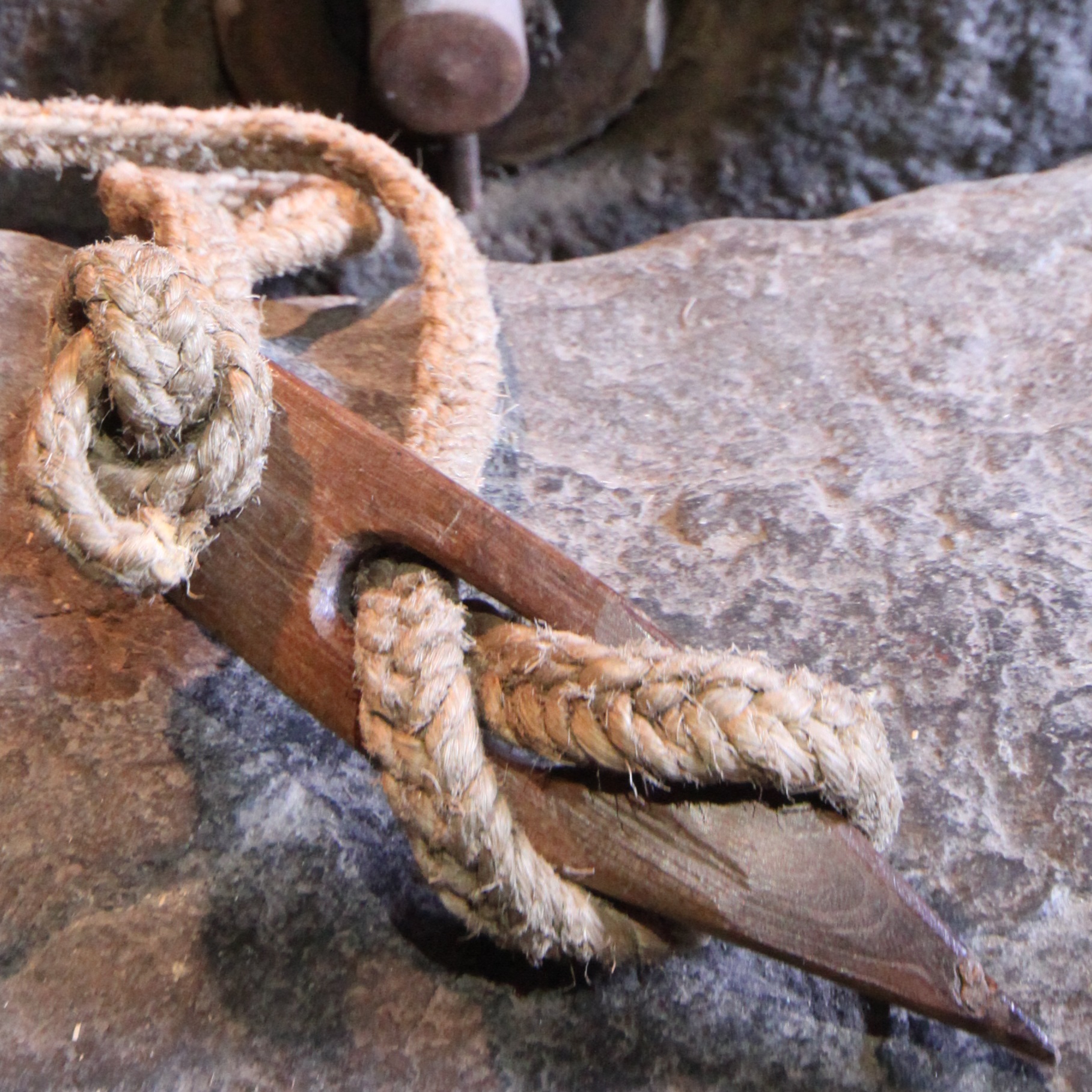
The handle or crank - Simona Molino
Why did Colombano write in Rome?
The Salbertrand Ecomuseum is dedicated to Colombano Romean, a miner and excavator of the Ramats, symbol of the hard and ungrateful work in the mountains.
For eight long years, starting from 1526, he dug an incredible work that still exists today: the Pertus, a gallery at 2000 meters above sea level, almost five hundred meters long with a section of about one meter and eighty by one meter, to bring the waters of the Rio Touilles to revive the entire slope above Chiomonte and Cels, well exposed but arid.
Path and sites
The Ecomuseum winds along a loop itinerary between the village of Salbertrand and the Gran Bosco di Salbertrand Natural Park, where ancient buildings, artifacts, and tools used in daily life tell centuries of history and exploitation of the territory's resources, constituting demonstrative points of productive activities carried out with traditional techniques.
The visitable sections of the Ecomuseum include the Hydraulic Mill of the Salbertrand Community and the Wood-fired Oven in the Oulme hamlet, which document the complete bread-making process by linking the various stages of cereal processing and illustrating the connections between the working world and the domestic one.
The Museum of the Treasures of the Parish hosted in the sacristy of the Church of San Giovanni Battista, and the Chapel of the Annunciation of Oulme, recently restored to its ancient splendor, testify to the religiosity and wisdom of a Community closely linked to its traditions.
Along the main street, two monumental Fountains in stone and the Hotel Dieu document the importance of the village of Salbertrand along the historical route of the Route de France.
Also visitable are the nineteenth-century Icehouse and a blockbau wooden reconstruction prototype of the Smoke-sauna designed by the great Finnish architect Alvar Aalto for his experimental house in Muuratsalo (Finland), a carbonile courtyard with the different stages of setting up a Charcoal Kiln in the woods, the Lime Kiln, the Forestry Yard, the Mine entrance, and the section dedicated to the Glorious Return.
Discover the Ecomuseum: the visits

The ecomuseum unfolds along a circular path of about five kilometers between the village of Salbertrand and the Gran Bosco Natural Park, along which the 13 currently visitable sites are encountered.
The ecomuseum is visitable by reservation and as part of the guided tours included each year in the events calendar of the Park Authority or during theatrical visits organized in collaboration with the Cultural Association ArTeMuDa.
For organized groups, guided tours by reservation are available, costing 200.00 Euros for a full day and 160.00 Euros for a half day.
Discounted rates are available for schools and youth groups. For more information, please consult the Rates page.
For individuals or small groups, special openings by reservation are available year-round.
To facilitate self-guided visits, a path equipped with appropriate signage and descriptive panels has been designed, which runs between the protected area and the ancient streets of the village of Salbertrand, and illustrative brochures have been created and can be found at the park's headquarters and local tourist offices.
In the absence of a guide, the sites are only visitable from the outside.
During the summer, the ecomuseum path is accessible with a guide every Tuesday (with an appointment at 14:30 in front of the parish church of Salbertrand) and Thursday (by reservation). Cost: full price 12.00 euros, reduced (6/16 years) 8.00 euros, free for children up to 5 years old inclusive.
Address of offices and visitor center:
Via Fransuà Fontan, 1 - 10050 Salbertrand (TO)
Tel. 0122 854720 - Fax: 0122 854421
Email ecomuseo.salbertrand@ruparpiemonte.it
Discovering the Ecomuseum: the projects
The Cahiers of the Ecomuseum
Since 1999, over 30 cahiers have been published in the series of the Cahiers of the Ecomuseum Colombano Romean over a period of 25 years.
Tales, collections of memories related to material and immaterial culture, research, recovery and restoration interventions are some of the topics that narrate the past and recent history of the community of Salbertrand and the Upper Susa Valley. Particular attention is paid to the local language, Occitan; many cahiers are written in bilingual form.

Ecomuseums Network of Piedmont
The Ecomuseum Colombano Romean is part of the Association "Network of Ecomuseums of Piedmont", established to support the cooperative activities of the Ecomuseums, created to:
- represent and protect the interests of the Network and its members towards institutions, other Italian and international entities;
- carry out research, study, reflection, comparison, design, and evaluation on issues of interest to ecomuseums;
- work together to optimize actions and resources and be more effective and efficient.
AIAMS
The Ecomuseum Colombano Romean is a member of the Italian Association of Friends of Historical Mills
The Ecomuseum Brochure
Ecomuseum Colombano Romean Brochure (visit route - in PDF format, 5 MB)
You might also be interested in...
- shopping_cart Hotel Dieu e Bachà 'd Méi 'd Viera - cahier n°25
- campaign Storia di un uomo e di un quadro
- campaign Colombano 500: Cinque secoli di storia, acque e comunità
- shopping_cart Ël grō blëtun - Il grande larice - Cahier n°1
- shopping_cart Lä Chäpella dl'Ulm - La Cappella dell'Oulme - Cahier n°9
- shopping_cart Ël mitī isüblià du charbunī - Il mestiere dimenticato del carbonaio - cahier n°14
- shopping_cart Dzerta - Territorio, storia e toponimi dell'ex Comune censuario di Desertes. - cahier n°20
- shopping_cart L'Occitania e la sua lingua. Incontri di antichi popoli, fusione di antiche civiltà - cahier n°21
- shopping_cart Piermenàou e Viararè - Pierremenaud e Villaret - cahier n°24
- shopping_cart Colombano Romean Ecomuseum